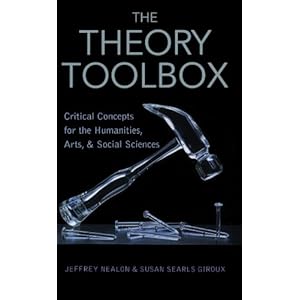
Chapter 13 of The Theory Toolbox focused primarily on “agency” as well as how power has an effect on the way we view agency. The chapter starts by defining power and agency by saying that “given a particular set of constraints on our subjectivities, what actions, operations, and powers can be brought to bear in an interpretation or analysis?” In other words, “agency” is described in this chapter as simply being the power to do something.
 |
| Theory Toolbox Ch. 13 |
Later in the chapter, the use of power and agency as well as history and its context comes into play. A quote that says, “We cannot ignore human agency in history. We cannot, in other words, ignore the fact that people create history by doing things; history is made rather than found.” This quote really made sense because it proved to me that subjects can always be agents because people on a day to day basis do things to create history. The ability to respond to historical contexts is what in fact embodies this idea of subjects having agents. “in light of such representations, the reminder that people are agents who make history is all the more necessary, given the inclination to view the present as inevitable, the future as nothing more than a repetition of the past”. Simply put, our agency is both constrained and enabled by the contexts in which we find ourselves.
 |
| Power & Authority |
Power comes into play in regards to agency by the example of using wealth presented in the chapter. For example, being wealthy often would translate into a much greater capacity to make choices, to take control over ones time, to enhance ones mobility; all of which create the conditions of improved health, security, and happiness; however not across all contexts. What I mean by this is that when looking at the contrary of wealth, being wealthy and having power also makes the individual an immense target and threat to scam or violence. In other words, representation or the way that others view us in a key role in how society identifies us. “The subject’s positions we occupy are never simply a function of what we choose for ourselves”. Power in other ways such as post-structuralism is an example of how power is illustrated by challenging the norms and what seems to be set in place by society; this idea of “universal truth”. “And such challenges require agency, our capacity to make choices and act, yet another form of power”.
 |
| Case of Beer |
An example of the power of choice in regards to agency and power presented in the chapter would be something like case day. Around campus on case day, majority of the students on campus wake up early in the morning to try and consume a case (24 beers). Although most don’t finish the case or those who do end up puking or passing out immediately after, making the choice to participate is an example of how contexts constrain us, yet also give us the means to respond specifically to situations and other people. What I mean by this is that although my example of case day is a bit wacky and bizarre, the ability and choice to respond to this event in town gives birth to the idea of agency. And even if one does not choose to participate in case day, the choice and ability to not respond or participate is somewhat a response in itself; one that has consequences and effects. So in conclusion, “Agency”, then, is always a response to already given contexts, and, as we’ve seen throughout the semester, in this sense the ways we respond to the everyday world are bundled up with the ways we respond to cultural contexts”.